
Equipment Development
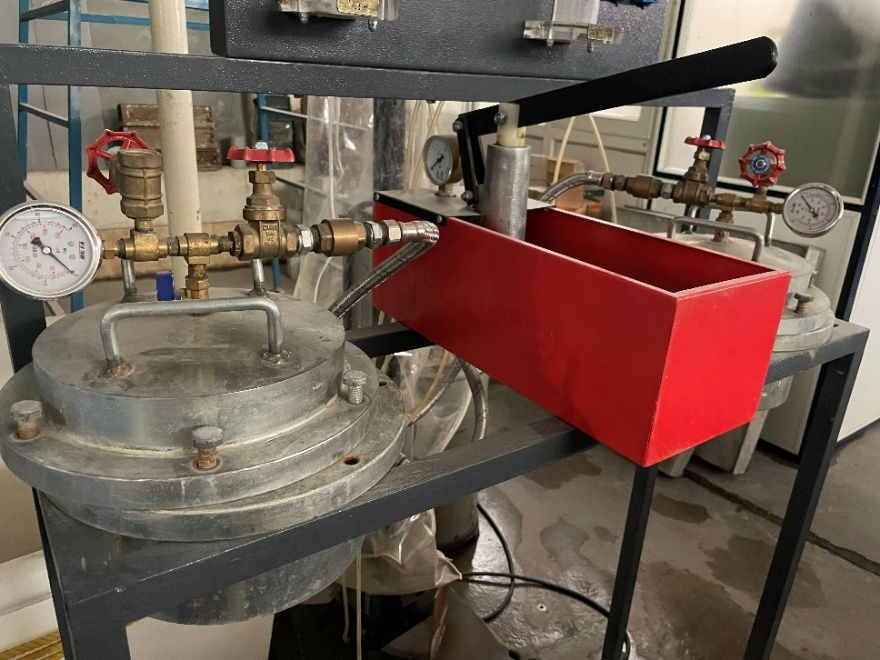
Permeability Apparatus
This device is equipped with two metal chambers, allowing the simultaneous testing of two cubic specimens. It also includes a manual pump for adjusting the water pressure, by means of which the desired pressure is established in the system. The pressure gauges are graduated up to 16 bar, and a set of high-pressure valves has been designed to control the flow of water and air. The device has two separate valves: one for water inlet and the other for air venting. Before applying pressure to the specimen, the air-venting operation must be carried out completely to prevent the presence of air bubbles in the flow path and to maintain the accuracy of the test.
In this test, the permeability of the concrete specimen is measured using a specialized device capable of applying water pressure up to a maximum of 12 bar. Depending on the water pressure required to saturate the specimen, the pressure is manually adjusted by the operator. The specimens must remain under constant pressure inside the device for 72 consecutive hours in order to achieve steady-state penetration conditions.
During this period, due to the nature of the specimen and the process of water penetration within it, a pressure drop may occur in the system. Therefore, it is necessary to manually recharge the system pressure at regular intervals so that the average pressure applied to the specimen remains constant. After the completion of the 72 hours, the specimens are removed from the device and split into two halves to measure the depth of water penetration across the specimen section.
During this period, due to the nature of the specimen and the process of water penetration within it, a pressure drop may occur in the system. Therefore, it is necessary to manually recharge the system pressure at regular intervals so that the average pressure applied to the specimen remains constant. After the completion of the 72 hours, the specimens are removed from the device and split into two halves to measure the depth of water penetration across the specimen section.
The dimensions of the specimens used must be cubic, measuring 15 × 15 cm. Two O-rings are installed in the device lid; before operation, they must be lubricated with grease or petroleum jelly so that during the test, the gap between the chamber and the specimen is fully sealed and water leakage is prevented.
Last Update: