Laboratory Equipment​​​​

Some of the most important laboratory equipment of the Earthquake Engineering Research Center include:
Responsive Image

Shaking Table Deck
​​​​​​​

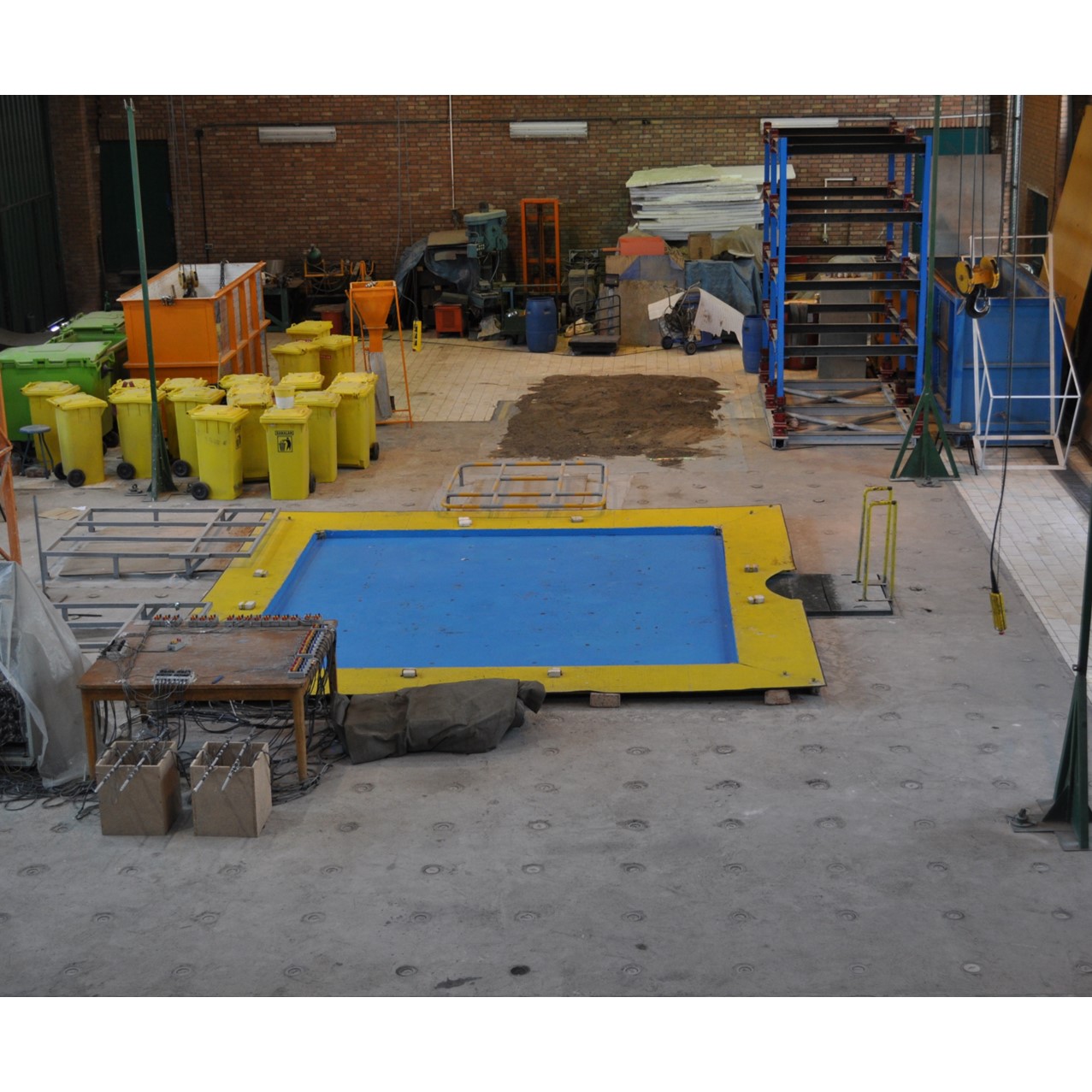
The shaking table deck measures 4 × 4 m, has a thickness of 65 cm, and weighs approximately 12 tons. It is mounted on four hinge-pivot supports, allowing motion along X and Y axes and rotation about the Z-axis. The deck was designed and constructed to provide a stable platform for various structural models. Due to its strength and relatively high first-mode frequency (152 Hz), it can accommodate complex dynamic testing of large-scale specimens.
​​​​​​​

Responsive Image

Control System
​​​​​​​

The shaking table control system is based on IST 8800 multi-channel LBTRONIC technology, enabling precise management of the actuators. It allows individual actuator control as well as simultaneous operation. The system can combine movements in the X and Y directions and rotation about the Z-axis. Key capabilities include applying harmonic and random loads, as well as simulating earthquakes using displacement or acceleration time histories.

​​​​​​​

Responsive Image

Hydraulic Actuators
​​​​​​​

The shaking table is equipped with a set of hydraulic actuators, including one actuator along the X-axis and two along the Y-axis. These actuators can apply both static and dynamic loads at large scales. Their dynamic load capacity reaches up to 500 kN along the X-axis and 400 kN along the Y-axis. The dynamic displacement of the actuators is up to 250 mm in X and 400 mm in Y. Other key features include high loading speed, adjustable frequency, and the ability to generate high acceleration (up to 40 m/s² for an empty table).

Responsive Image

Hydraulic Power Supply
​​​​​​​

The operation of the shaking table actuators is supported by a high-capacity hydraulic power supply. This system is designed with a pumping capacity of 250 L/min and an operating pressure of 280 bar, enabling loading at various frequencies. The oil tank has a volume of 1,300 L, and the system’s power consumption is 160 kVA (equivalent to 250 A). Such a power supply allows the laboratory to simulate conditions similar to real earthquakes while ensuring stable performance of the actuators throughout the experiments.